 Save
Save There's something almost magical about watching egg whites transform into clouds. The first time I made an angel food cake, I was in my grandmother's kitchen on a humid summer afternoon, and she stood beside me, whispering instructions about how the bowl had to be spotless, how the eggs had to be cold from the fridge then brought to room temperature—the little paradoxes that make baking feel like a secret language. When that fluffy batter went into the oven and came out golden and impossibly light, I understood why this cake has been passed down through generations.
I remember bringing one of these cakes to a neighborhood potluck in late July, nervous that it might seem too simple next to the elaborate desserts everyone else brought. But watching people's faces light up when they tasted that airy sweetness paired with fresh strawberries—that's when I realized this cake doesn't need frosting or fancy decorations to win hearts.
Ingredients
- Cake flour: The secret to that cloud-like crumb; all-purpose flour is too dense and will make your cake heavy, but the sifting technique matters as much as the flour itself.
- Granulated sugar: Divided into two portions so it dissolves completely—one part goes into the dry mixture, the other whips into the meringue for stability.
- Fine salt: A tiny amount that somehow makes the sweetness sing without adding a salty taste.
- Egg whites: They must be at room temperature and absolutely free of any yolk, or the whole thing collapses; I learned this lesson the hard way with a sad, dense cake years ago.
- Cream of tartar: This acidic powder stabilizes the meringue and gives the whites something to cling to as they rise.
- Vanilla and almond extracts: The almond is optional, but it adds a subtle floral note that makes people ask what the secret ingredient is.
Tired of Takeout? 🥡
Get 10 meals you can make faster than delivery arrives. Seriously.
One email. No spam. Unsubscribe anytime.
Instructions
- Prepare your pan and oven:
- Preheat to 350°F and make sure your 10-inch tube pan is impeccably clean and completely dry; even a hint of grease will prevent the batter from clinging to the sides. This is non-negotiable.
- Sift the dry team three times:
- Whisk cake flour, three-quarters of the sugar, and salt together, then pass it through a sifter three times. This aerates the flour and ensures every ingredient is evenly distributed, giving you that signature tender crumb.
- Beat egg whites to glossy peaks:
- Start with medium-high speed until they're foamy, add cream of tartar, then keep beating until soft peaks form—they should look like a cloud that holds its shape but still curls over when you lift the beater. This takes patience; rushing here means a dense cake.
- Add sugar gradually and reach stiff peaks:
- Sprinkle the remaining sugar in slowly while beating, watching as the meringue transforms into something glossy and voluminous that can hold stiff peaks; this is where the magic happens. Add vanilla and almond extracts gently at the end, folding by hand.
- Fold in the flour with a gentle hand:
- Sift the flour mixture over the meringue in three additions, folding with a spatula after each one—press the spatula to the bottom of the bowl and cut through the center, rotating the bowl slightly with each stroke. Stop as soon as you don't see any white streaks; overmixing deflates all that air you just built.
- Pour and smooth the batter:
- Spoon it into the ungreased pan and smooth the top, then run a thin knife through the batter in a zig-zag pattern to pop any large air pockets that would create holes. This step feels counterintuitive, but it actually improves the crumb.
- Bake until golden and springy:
- Bake for 35 to 40 minutes—the top should be light golden and the cake should spring back immediately when you touch it lightly with your finger. If it jiggles or feels damp, give it another minute or two.
- Invert while hot:
- The moment it comes out of the oven, flip the pan upside down onto a bottle or cooling rack; the hot cake needs to hang like this as it cools so it doesn't collapse. This takes about 1 to 2 hours, and you have to resist the urge to check on it.
- Release from the pan:
- Once completely cool, run a thin knife around the inner and outer edges, wiggling gently, and the cake should slide out intact. If it sticks, you may have had moisture in the pan—this is the only real way to ruin it after all that work.
- Finish simply or dress it up:
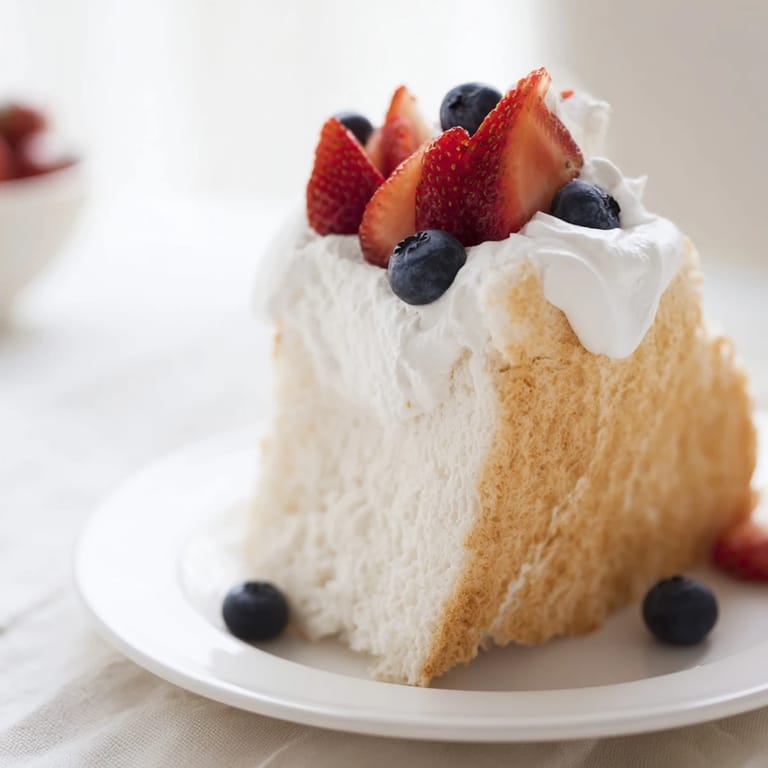
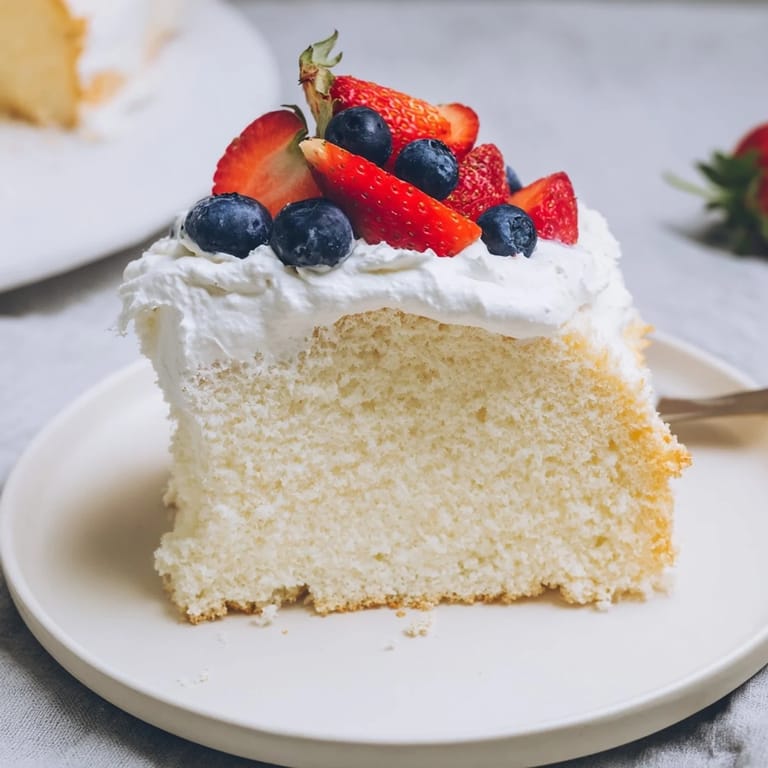
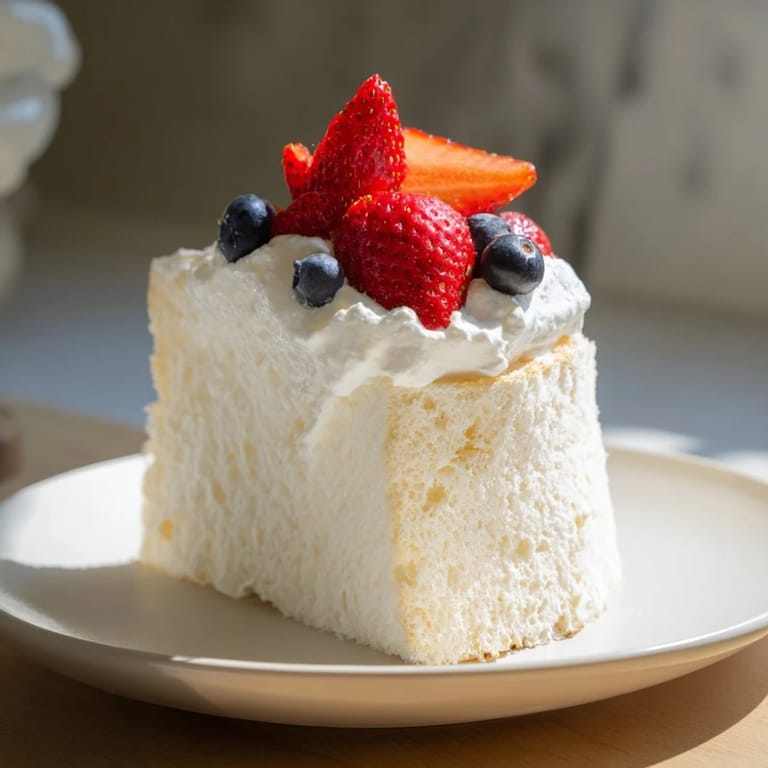
- Serve plain so you taste that delicate flavor, or pile fresh berries on top and dollop with whipped cream for something that feels almost decadent.
 Save
Save The moment that sticks with me most is when my daughter, who was maybe seven, watched the whole process and asked why we were making a cake that looked like it was made of air. I realized then that angel food cake is about patience and trust—you follow the rules carefully, and something almost impossibly light emerges.
The Science of Stiff Peaks
There's real chemistry happening in your bowl. Egg whites are mostly water and protein, and when you beat them, you're trapping thousands of tiny air bubbles inside a protein matrix—cream of tartar helps stabilize this structure by lowering the pH, which strengthens the proteins. Sugar does two things: it dissolves into the water, making the meringue thicker and shinier, and it pulls moisture from the proteins, which is why you add it gradually. This is why dumping all the sugar in at once makes everything collapse—the proteins can't handle it. The whole science is beautiful in its precision.
Why This Cake Feels Special
Angel food cake exists in this rare category of desserts that feel fancy and light but don't require cream, butter, or chocolate—it's pure, almost innocent. It's the cake you serve when someone's recovering from an illness, when you want something refreshing on a hot day, or when you want to prove to yourself that you can do something technically difficult. There's no room to hide behind rich flavors; the cake itself has to shine. That's what makes it challenging and rewarding in equal measure.
Serving and Pairing Ideas
Fresh berries are the obvious choice, and they're perfect—the tartness plays beautifully against the sweetness. But I've also served this cake with a light lemon curd, a berry coulis that looks elegant on the plate, or simply dusted with powdered sugar for something simple. A scoop of vanilla ice cream on top, melting into the crumb, is another quiet joy. The lightness of the cake means it won't feel heavy even when you pair it with cream or fruit compotes.
- A sparkling wine like Prosecco or Champagne is surprisingly perfect alongside a slice.
- Mint leaves scattered on top add a refreshing visual note and a whisper of flavor.
- Make it the day before serving and wrap it loosely so the crumb stays tender but the exterior doesn't dry out.
 Save
Save This cake reminds me that some of the most elegant things come from simplicity and precision, not complexity. Every time someone tastes it and says it's so light it feels like eating a cloud, I think of my grandmother in that kitchen, reminding me that the best recipes are the ones we slow down for.
Recipe FAQs
- → What is the key to achieving the cake's airy texture?
Whipping the egg whites to stiff, glossy peaks and gently folding in sifted flour ensures a light, airy texture.
- → Why should the pan remain ungreased?
Keeping the tube pan ungreased allows the batter to cling to sides and rise properly during baking.
- → How should the cake be cooled for best results?
Invert the pan upside down on a bottle or rack to cool completely, preserving the cake's height and texture.
- → Can almond extract be omitted without affecting taste?
Yes, almond extract is optional and offers a subtle nutty note but can be left out for a more neutral flavor.
- → What substitutes can be used for cake flour?
Use all-purpose flour with cornstarch (removing 2 tablespoons AP flour and adding 2 tablespoons cornstarch) to mimic cake flour's lightness.